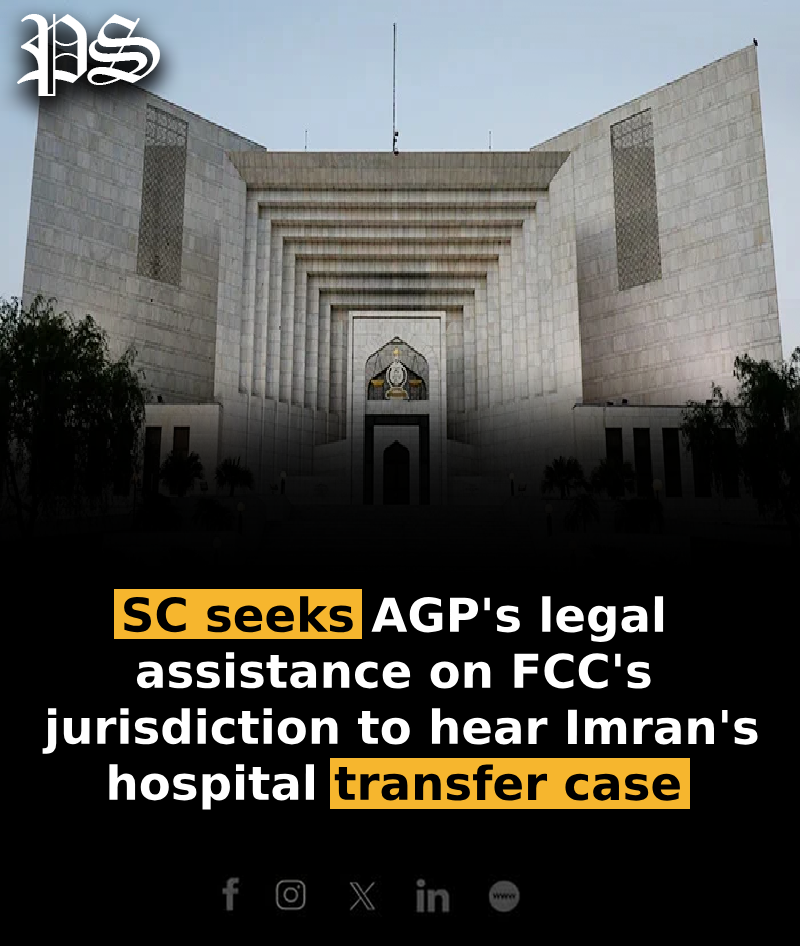


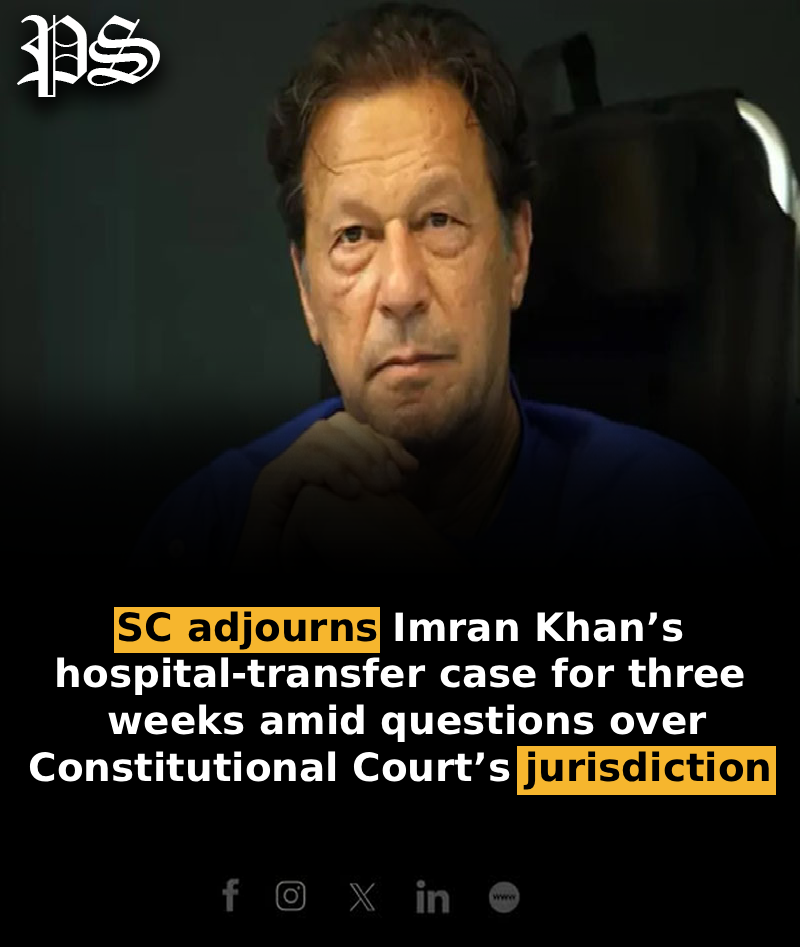
ISLAMABAD: The Supreme Court on Wednesday adjourned for three weeks the hearing of PTI founder and former prime minister Imran Khan’s hospital-transfer case after Attorney General Mansoor Usman Awan assisted the bench on a jurisdictional dispute triggered by the Federal Constitutional Court’s decision to summon records of the case.
The hearing was marked by questions from Justice Shahid Waheed about the scope of the FCC’s powers, including whether it could summon cases pending before the Supreme Court and whether its orders were binding on the apex court. The bench headed by Justice Waheed comprising Justice Naeem Akhtar Afghan and Justice Ishtiaq Ibrahim, resumed the hearing of petitions related to former prime minister and Pakistan Tehreek-e-Insaf (PTI) Imran Khan’s medical treatment and meetings with his family members.
The proceedings resumed after a break with Awan reading out the FCC’s order, which directed that records of cases pending before the Supreme Court be summoned and the cases subsequently fixed for hearing.
“Under the Constitution, the Constitutional Court can summon not only the record of cases but also the cases themselves,” Awan told the court.
Justice Waheed questioned the wording of the order, particularly its direction that the cases be fixed before the FCC.
“The order says that after summoning the records, the cases should be fixed for hearing,” he said. “The phrase ‘fix the cases’ is troubling us.”
Awan said the court first needed to determine the extent of the FCC’s power to summon records.
“It has to be determined how and from where the Constitutional Court can summon records,” he said.
“The primary question here is what the jurisdiction of this court is,” Awan added.
Justice Waheed said the bench’s questions were aimed at understanding the constitutional framework rather than creating a confrontation between the two superior courts.
“We want to understand the intent of the Constitution,” he said. “We believe in mutual respect among the judiciary.”
“Please do not take these questions negatively; they are only being asked for the purpose of understanding,” the judge added.
Quran, Sunnah and constitutional jurisdiction
The discussion then turned to the extent of the FCC’s jurisdiction in matters concerning the Quran and Sunnah.
“The Constitutional Court cannot interfere in matters concerning the Quran and Sunnah,” Justice Waheed said. “The Constitutional Court can only interpret the Constitution.”
“Apart from constitutional interpretation, all matters fall within the Supreme Court’s jurisdiction,” he added.
Awan said the Supreme Court’s Shariat Bench retained the authority to interpret the Quran and Sunnah.
“The Shariat Bench of the Supreme Court can interpret the Quran and Sunnah,” he said.
Justice Waheed then questioned whether the FCC would be bound by Supreme Court judgments based on the Quran and Sunnah.
“There is nothing above the Constitution, the law and the Holy Quran in the country,” he said.
“Will the Constitutional Court not be bound by a Supreme Court judgment made in light of the Quran and Sunnah?” the judge asked.
Awan responded that Article 189 of the Constitution was clear regarding the application of judicial decisions.
“Article 189 is clear regarding the application of judgments,” he said.
The attorney general also said he would limit his assistance to the question of jurisdiction.
“I will not comment on questions concerning the Constitutional Court,” Awan said. “I will assist the court on the issue of jurisdiction.”
“This is the first case of its kind,” he added.
Fundamental rights also under scrutiny
Justice Waheed also questioned the FCC’s order concerning cases involving fundamental rights.
“The Constitutional Court’s order says it will determine which court can hear cases involving fundamental rights,” he said.
“The issue of fundamental rights arises in every case,” the judge added. “The fundamental right to a fair trial arises in every criminal case.”
Awan maintained that the jurisdictions of the two courts were defined by the Constitution.
“The jurisdictions of the Constitutional Court and the Supreme Court are clearly defined in the Constitution,” he said.
Justice Waheed then questioned whether the Supreme Court was bound by the FCC’s order.
“Can the order issued by the Constitutional Court be applied to us?” he asked.
“Are we bound by the order of the Constitutional Court?” he further questioned.
The judge also asked whether the Supreme Court should dismiss the petitions or refrain from hearing them while the jurisdictional question remained unresolved.
“Should the court dismiss the petitions today or decline to hear them?” Justice Waheed asked.
Jail officials absent despite summons
The bench also expressed displeasure over the absence of government officials, including Adiala Jail authorities, who had been summoned to appear in person.
“Adiala Jail authorities had been summoned in person today,” Justice Waheed said. “None of the government officials appeared.”
“The Supreme Court’s order has been violated,” he said, adding that there was “a severe lack of trust and communication.”
Awan acknowledged that the officials should have appeared but asked the court to give them another opportunity.
“The government officials should have appeared today,” he said.
Justice Waheed asked, “Should we issue warrants for the jail superintendent?”
“It would be appropriate to give them one opportunity,” Awan responded.
He suggested that the officials may have believed the hearing would not take place.
“The officials may have understood that the case would not be heard today,” he said.
Justice Waheed also referred to the government’s position in its review petition that treatment could not be provided at a private hospital.
“The government has stated in its review petition that treatment cannot be provided at a private hospital,” he said.
“The Supreme Court’s order was not implemented,” the judge added.
Awan told the bench that the record sought by the court had been provided.
“The record has been provided in compliance with the court’s order,” he said.
Hearing began without govt representative
Earlier, no government representative had initially appeared before the court, prompting the bench to summon Awan.
Barrister Ali Zafar appeared on behalf of Mishal Yousafzai, while Additional Attorney General Rana Asad appeared later.
Rana informed the bench that the FCC had taken up the matter from the Supreme Court a day earlier and had issued an order to that effect.
“The Federal Constitutional Court took the case from the Supreme Court yesterday,” he told the bench.
Justice Waheed directed Rana to read out the FCC’s order.
After the order was read in court, the judge asked whether the attorney general was in his office.
“Yes, the attorney general is present,” Rana replied.
“Then call the attorney general,” Justice Waheed directed.
The Supreme Court subsequently summoned Awan, after which the judges left the courtroom and the hearing was adjourned for a second time.
FCC intervention raises jurisdiction issue
The FCC’s decision to seek the record of Khan’s hospital-transfer case from the Supreme Court raised a jurisdictional question ahead of the apex court’s hearing of a contempt petition over the alleged non-implementation of its Aug 18 order.
The FCC’s three-member bench, headed by Chief Justice Aminuddin Khan, issued the order while hearing petitions filed by three Adiala prisoners seeking permission to receive treatment at private hospitals. It directed its registrar to obtain Khan’s case record, along with records of similar matters pending before the Supreme Court and high courts.
The move followed arguments by Awan that the FCC had the power under Article 175E(5) of the Constitution to call for the record of a case pending before any court where it involved a substantial question of law relating to constitutional interpretation.
Justice Ali Baqar Najafi asked whether the government had raised the jurisdictional objection before the Supreme Court. Awan said an additional attorney general had done so, but the Supreme Court issued its Aug 18 order without giving the government notice.
Justice Najafi also questioned whether the Supreme Court should first have determined the maintainability of the petition.
Justice Aamer Farooq noted that the matter before the Supreme Court was criminal in nature and that its Aug 18 order was interim.
Khan’s hospital-transfer order
On Aug 18, the Supreme Court ordered that Khan be shifted from Adiala jail to Shifa International Hospital for medical examination and treatment in the presence of his sister, Dr Uzma Khan, and physician Dr Faisal Sultan.
Khan was instead taken to PIMS for examination before being returned to Adiala.
Dr Uzma subsequently filed a contempt petition, alleging that the government had failed to implement the Supreme Court’s directive.
The FCC proceedings stemmed from petitions filed by three Adiala prisoners who also sought permission to receive treatment at private hospitals. The Islamabad High Court had rejected their pleas, holding that prisoners did not have a legal or fundamental right to treatment at a private hospital of their choice, while noting that transfer could be permitted if recommended by a medical board and the required treatment was unavailable at a government hospital.
The FCC’s intervention comes against the backdrop of the 27th Constitutional Amendment, which established the court and altered the distribution of constitutional jurisdiction. In previous judgments, the FCC has held that its decisions are binding on all courts, including the Supreme Court, while the binding effect of Supreme Court judgments under Article 189 does not extend to the FCC.
At the close of Wednesday’s proceedings, the petitioners’ counsel told the court, “We have filed two contempt of court petitions.”
The Supreme Court then began dictating its order and accepted Awan’s request to defer the hearing.
“In these circumstances, we accept the Attorney General’s request that the hearing be adjourned,” the court said.
Justice Waheed told Awan: “We have complete confidence in you, Attorney General.”
The hearing was adjourned for three weeks.
PAK SOUCH MEDIA GROUP
Daily Pak Souch Newspaper Sukkur – Daily Pak Special Newspaper Karachi – Daily Pak Today Newspaper Karachi – Daily
Pak Jazbo Newspaper Sukkur
Head Office : Ayub Gate Shaikh Muhalla Near Rabbania Masjid Sukkur
Karachi Office : Office No. 1901-B, 19th Floor Saima Trade Tower (B) Block I.I Chandigarh Road Near Jung Press, Shaheen Complex & National Museum of Pakistan Karachi Sindh Pakistan.
Contact : 03009319022
Website 1 : https://paksouch.com/
Website 2 : https://sindhi.paksouch.com/
Website 3 : https://pakjazbo.com/
Website 4 : https://urdu.pakjazbo.com/
About The Author