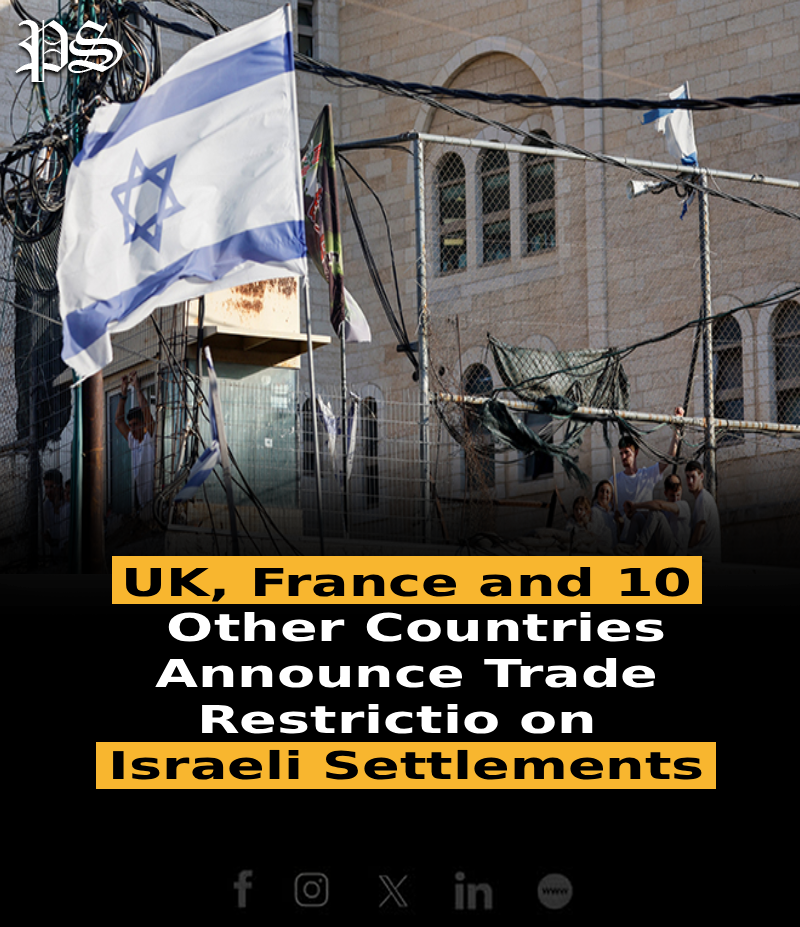
London: The United Kingdom, France, Canada and nine other countries have announced measures to restrict or support sanctions on trade involving products from Israeli settlements in the occupied West Bank.
In a joint statement, the 12 countries said that Israeli government actions in the West Bank were undermining the prospects of a two-state solution. The countries said they would either impose national-level restrictions on trade with settlements deemed illegal under international law or support European sanctions targeting such trade.
The countries named in the statement are Canada, Denmark, Finland, France, Iceland, Ireland, Norway, Poland, Portugal, Spain, Sweden and the United Kingdom.
British Foreign Secretary David Lammy announced the trade restrictions while addressing the House of Commons. He said Britain could no longer limit itself to simply “speaking out” against what it considers injustice and that the time had come for “practical action” in opposition to the expansion of Israeli settlements.
Lammy also said that the Israeli occupation of the West Bank was illegal and reiterated Britain’s position regarding alleged violations against Palestinians in the occupied territory.
Meanwhile, French Foreign Minister Jean-Noël Barrot announced on social media platform X that France would join the other 11 countries in ending or restricting trade with Israeli settlements in Palestinian territories.
Barrot said the situation in the West Bank had become increasingly tense, citing rapid settlement expansion and a rise in violence against Palestinians allegedly carried out by extremist settlers.
However, according to international news reports, the precise mechanism and timing for implementing the announced trade restrictions have yet to be determined.
The measures are also expected to have a relatively limited immediate impact on overall UK-Israel trade, which is reportedly worth around £6 billion ($8.12 billion) annually. One major challenge is determining how products manufactured in West Bank settlements can be distinguished from goods produced elsewhere in Israel.
The announcements represent a significant diplomatic move by the participating countries, particularly as they seek to pressure Israel over settlement expansion and preserve the possibility of a future two-state solution.
About The Author