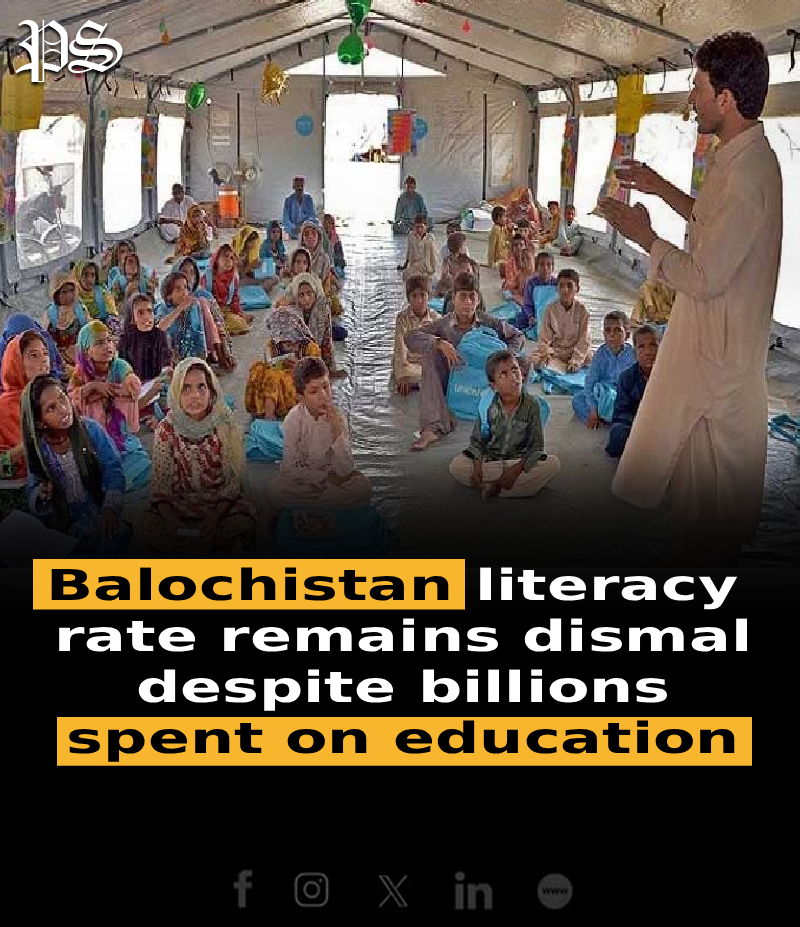
Over the past two years, the Balochistan government has spent more than Rs300 billion on education. Yet the province continues to record one of the country’s lowest literacy rates. The stark gap suggests that increasing education spending alone has not been enough to overcome Balochistan’s educational crisis.
Balochistan is Pakistan’s largest province by area, covering 347,190 sq-km, but the smallest by population, with about 14.9 million people. Despite billions of rupees allocated to education every year, along with foreign funding aimed at improving its underdeveloped education system, access to schools and the quality of education remain major challenges.
The scale of the problem is particularly visible in the province’s scattered settlements. Nazar Khan Barech, an educationist, said only about 12,000 of Balochistan’s 23,000 settlements have access to schooling facilities, leaving thousands without schools. The figure points out an alarming situation in Balochistan’s education system.
An opposition leader in the Balochistan Assembly, Maulana Hidayatur Rehman, was of the view that the province was facing serious educational backwardness, with a large number of children still out of school.
However, there has been some progress. According to the Pakistan Bureau of Statistics, Balochistan’s literacy rate has risen from 43% to 49% over the past five years. But the improvement has done little to close the gap with other provinces, while disparities within Balochistan remain striking.
Kech district of Balochistan has the province’s highest literacy rate, at 63%, while Washuk district has the lowest, at just 21%. The disparity is particularly stark in Dera Bugti, the home district of Chief Minister Balochistan Sarfraz Ahmed Bugti, where the overall literacy rate is 24% and female literacy stands at only 10%.
The education department’s additional Director Munir Ahmed points to the rise in literacy as evidence that its policies are producing results. Its 2024-25 report records an increase in the province’s literacy rate from 43% to 49% over five years.
But literacy figures alone do not tell the full story. A rise of six percentage points is difficult to celebrate when thousands of settlements still lack schools and large numbers of children remain outside the education system.
Experts are of the view that improving literacy in Balochistan will require more than announcing new projects or allocating larger budgets. The government needs a sustained, province-wide strategy that focuses on enrolling the children into primary schools.
That means improving teacher attendance, expanding access to education for girls, strengthening the quality of the curriculum and ensuring that schools have basic facilities. It also requires better monitoring of how education funds are spent and whether they are reaching the children and communities that need them most.
For Balochistan, the challenge is therefore not simply how much money is being spent on education, but whether that money is translating into functioning schools, regular teachers, enrolled children and better learning outcomes. Until that link is established, billions of rupees in education spending may continue to produce numbers on paper without transforming the lives of the province’s children.
About The Author