


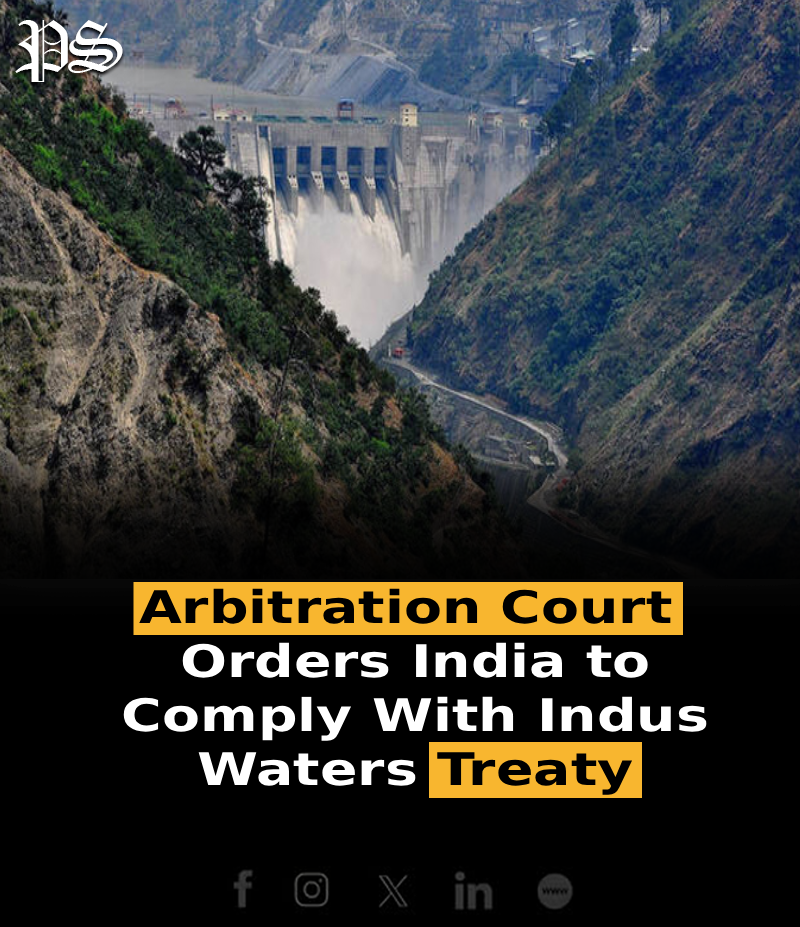
THE HAGUE: An international arbitration tribunal in The Hague has directed India to comply with its obligations under the Indus Waters Treaty (IWT) in a dispute concerning Indian hydropower projects on rivers covered by the agreement.
The ruling is part of ongoing arbitration proceedings initiated by Pakistan over the design and operation of Indian hydroelectric projects. The Permanent Court of Arbitration has previously held that the treaty does not permit either party to unilaterally place the arbitration process or related treaty mechanisms on hold.
C
Centre for International Law
+1
The dispute centres on India’s hydropower projects on the western rivers of the Indus system, relations between Islamabad and New Delhi have deteriorated sharply in recent years, placing the treaty under unprecedented pressure. Pakistan says the agreement which are allocated to Pakistan under the 1960 treaty, while India has certain permitted uses subject to treaty restrictions.
Pakistan has consistently maintained that the Indus Waters Treaty remains a binding international agreement and that India must observe its provisions. Islamabad has also rejected India’s unilateral decision to place the treaty in abeyance, describing the move as having no legal basis.
R
Radio Pakistan
+1
The arbitration proceedings have focused, among other issues, on whether the design features of Indian run-of-river hydroelectric projects comply with the limits imposed by the treaty. India has not participated in the arbitration proceedings despite being invited to do so.
G
Global Security
Dispute Over Hydropower Projects
Pakistan has raised objections to several Indian hydropower projects, arguing that their design and operation could affect downstream water flows.
The Court of Arbitration established under the treaty has already issued decisions concerning its competence and the interpretation of the Indus Waters Treaty. In 2025, it ruled that neither the treaty nor customary international law allows a party to unilaterally suspend the arbitration proceedings.
C
Centre for International Law
The latest development adds further weight to Pakistan’s position that disputes over the shared river system should be addressed through the legal mechanisms provided under the treaty rather than through unilateral measures.
Pakistan has repeatedly called on India to return to full compliance with the agreement and resolve outstanding water disputes through dialogue and established international mechanisms.
Background
The Indus Waters Treaty was signed in 1960 by Pakistan and India under the auspices of the World Bank. The agreement allocated the three eastern rivers — Ravi, Beas and Sutlej — primarily to India, while the three western rivers — Indus, Jhelum and Chenab — were allocated primarily to Pakistan, subject to specified rights and limitations for both countries.
R
Radio Pakistan
The treaty survived several wars and periods of severe political tension between the two countries and has long been regarded as an important framework for managing their shared water resources.
However, relations between Islamabad and New Delhi have deteriorated sharply in recent years, placing the treaty under unprecedented pressure. Pakistan says the agreement remains legally binding, while India has challenged the continuation of the treaty and the arbitration process.
The latest arbitration proceedings are therefore being closely watched in both countries, as any decision concerning Indian hydropower projects could have significant implications for Pakistan’s water security and the future implementation of the Indus Waters Treaty.
C
R
G
Sources
About The Author