

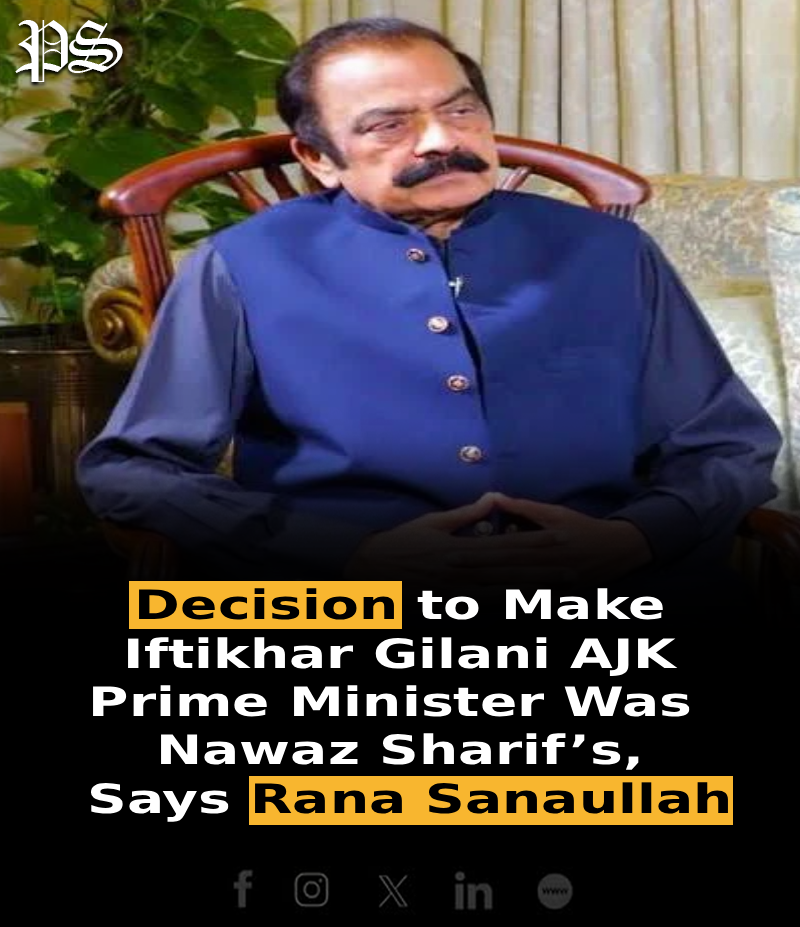
ISLAMABAD: Adviser to Prime Minister Shehbaz Sharif on Political Affairs and Senator Rana Sanaullah has said that the decision to appoint Barrister Iftikhar Gilani as the Prime Minister of Azad Jammu and Kashmir was made by Pakistan Muslim League-Nawaz (PML-N) supremo Nawaz Sharif.
Speaking during Geo News’ programme Jirga, Rana Sanaullah said the decision to nominate Iftikhar Gilani for the top office in Azad Kashmir was taken by the party leadership in consultation with Nawaz Sharif.
He said that the decision had been difficult for the party leadership, but after considering the circumstances, the leadership ultimately decided in favour of Iftikhar Gilani.
Rana Sanaullah rejected the impression that the decision had caused injustice to any party leader or member. He maintained that no one had been treated unfairly as a result of the decision to nominate Gilani as prime minister.
The PML-N leader said the party leadership had taken the decision after careful consideration and that the selection of Iftikhar Gilani should not be viewed as an act against any other leader within the party.
He also spoke about the position of Shah Ghulam Qadir, who serves as the president of the PML-N in Azad Kashmir. Rana Sanaullah said that Shah Ghulam Qadir was the party president and would remain with the party under all circumstances.
He emphasized that the party would continue to value Shah Ghulam Qadir’s role and experience. According to Rana Sanaullah, both Shah Ghulam Qadir and former AJK prime minister Raja Farooq Haider would be included in the new political team.
His remarks appeared aimed at addressing concerns regarding internal party dynamics following the selection of Iftikhar Gilani as prime minister.
Iftikhar Gilani, a PML-N leader, was recently elected as the 17th Prime Minister of Azad Jammu and Kashmir. He secured 30 votes in the AJK Legislative Assembly, defeating Pakistan Peoples Party candidate Sardar Mukhtar Khan, who received 14 votes.
The election marked an important political development in Azad Kashmir and placed Gilani in charge of the regional government.
Gilani entered the Azad Kashmir Legislative Assembly for the first time in 2011 after being elected as a member. During his political career, he also served as the Minister for Education in Azad Jammu and Kashmir.
His political experience in the legislative assembly and his previous role in the AJK government were among the factors associated with his political profile before his election as prime minister.
Rana Sanaullah’s comments provide insight into the decision-making process within the PML-N leadership regarding the selection of the new AJK prime minister.
According to him, the final decision was taken by the party leadership and Nawaz Sharif after a difficult internal deliberation. He stressed that the decision should not be interpreted as an attempt to sideline or undermine other senior figures in the party.
The issue of party unity has become particularly important following the change in leadership in Azad Kashmir. Shah Ghulam Qadir’s position as PML-N AJK president and Raja Farooq Haider’s experience as a former prime minister make both figures significant within the party’s political structure.
Rana Sanaullah said that both leaders would be included in the new team, suggesting that the party leadership intends to maintain their involvement in political and governmental affairs.
The statement also indicates that the PML-N leadership is seeking to maintain unity among its senior representatives following the appointment of Gilani.
Iftikhar Gilani’s election was based on a majority of votes in the AJK Legislative Assembly. His 30 votes were more than double the 14 votes secured by his rival candidate from the Pakistan Peoples Party.
As the newly elected prime minister, Gilani is now expected to lead the government and address political, administrative and development-related issues facing Azad Jammu and Kashmir.
His previous experience as a legislator and education minister could provide him with familiarity with the region’s administrative and political affairs.
The appointment has also placed renewed attention on the internal structure of the PML-N in Azad Kashmir. Rana Sanaullah’s assurance regarding Shah Ghulam Qadir and Raja Farooq Haider appears intended to reinforce the message that senior party figures will continue to have an important role.
Rana Sanaullah reiterated that no injustice had been done to anyone through the decision to appoint Gilani. He said the selection was the result of a difficult but deliberate decision by the party leadership.
The remarks also underline the influence of Nawaz Sharif in major political decisions within the PML-N. According to Rana Sanaullah, Nawaz Sharif personally backed the decision to make Iftikhar Gilani the prime minister of Azad Kashmir.
With Gilani now taking charge, attention is expected to shift toward the priorities of his administration and the composition of his political team.
The inclusion of experienced figures such as Shah Ghulam Qadir and Raja Farooq Haider could help the new government maintain broader political support within the party.
For now, the PML-N leadership appears focused on presenting the change as a collective party decision rather than a move against any individual. Rana Sanaullah’s statement that no one was treated unfairly is likely to be viewed in the context of maintaining party cohesion following the leadership transition.
Iftikhar Gilani’s election as the 17th prime minister represents a new chapter in the political leadership of Azad Jammu and Kashmir. With the backing of the PML-N leadership and Nawaz Sharif, Gilani will now be responsible for leading the regional government and managing the political and administrative challenges ahead.
About The Author