

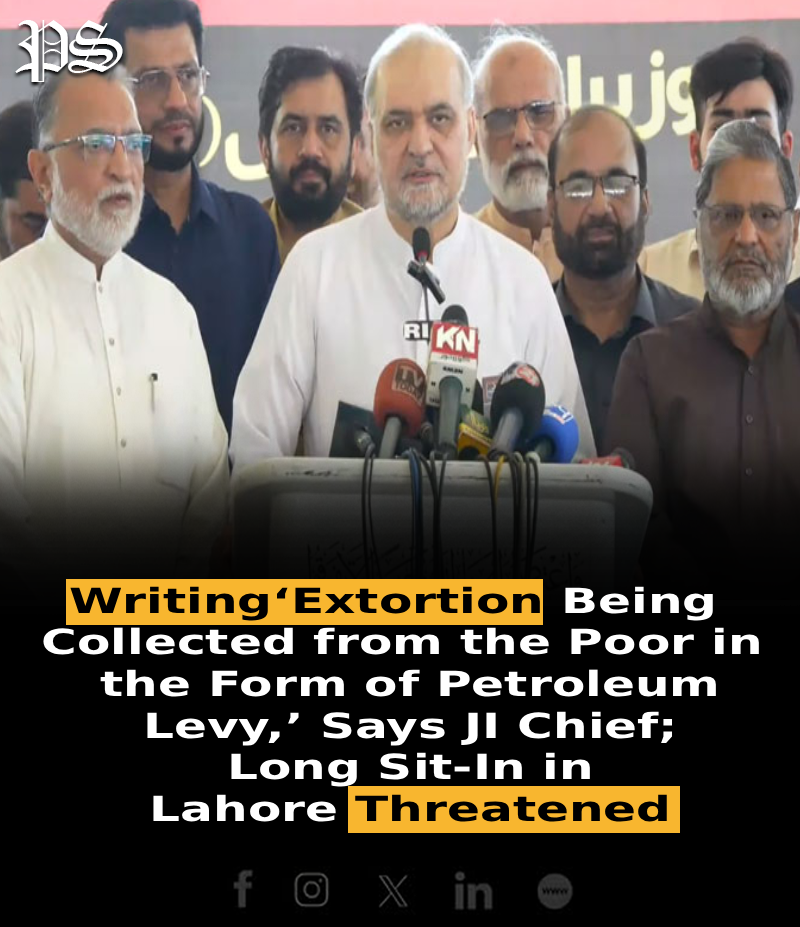
LAHORE: Jamaat-e-Islami (JI) Emir Hafiz Naeemur Rehman has warned that his party could stage a prolonged sit-in in Lahore against the petroleum levy, accusing the government of placing an unfair financial burden on ordinary citizens.
Addressing a press conference in Lahore, the JI chief said that a nationwide political and public struggle had begun in the form of protests and sit-ins against rising prices, taxes and what he described as anti-people government policies.
Hafiz Naeem said protests were being held at hundreds of locations across the country and were creating greater public awareness about the economic difficulties being faced by citizens. He claimed that people were increasingly becoming conscious of the financial pressures imposed on them through taxes, fuel prices and utility costs.
Criticising the government’s petroleum pricing policy, the JI emir said petrol prices were not being reduced despite changes in international oil prices. He questioned why consumers were not receiving the benefit of lower prices in the global market.
He accused the government of collecting what he described as “extortion” from the poor through the petroleum levy. According to him, the levy had become an additional burden on citizens who were already struggling with inflation and declining purchasing power.
Hafiz Naeem also criticised the political legitimacy of the federal government, alleging that it was not genuinely representative of the people. Referring to the controversy surrounding the 2024 general elections, he described the administration as a “Form 47 government,” a term frequently used by opposition parties to question the election results and the allocation of seats.
The JI leader said the government should reduce its own expenditure instead of continuing to impose additional financial burdens on ordinary citizens. He claimed that the federal government’s own expenses had reached around Rs1 trillion, while citizens continued to face severe power shortages and prolonged load-shedding.
He argued that government institutions should lead by example by reducing unnecessary expenditure and adopting austerity measures. Hafiz Naeem specifically said that official vehicles used by government officials should not have engine capacities exceeding 1,300cc, suggesting that expensive vehicles represented unnecessary expenditure at a time when the country was facing an economic crisis.
The JI emir warned that his party was prepared to intensify its campaign if the government failed to respond to public concerns. He said the party could organise a long-term sit-in in Lahore, indicating that the protest movement could continue for an extended period rather than being limited to a one-day demonstration.
He also invited all political parties to participate in the proposed sit-in, saying that the issue was not limited to Jamaat-e-Islami but concerned the wider population. He urged political groups to join the campaign against policies that, in his view, were increasing the financial burden on ordinary citizens.
Hafiz Naeem further issued a strong warning against any attempt to remove JI protesters from the sit-in. He said that if anyone tried to force the protesters to leave, they could “fulfil their desire,” signalling that his party would resist attempts to end its demonstration through pressure.
The remarks come as Jamaat-e-Islami continues its protest campaign against the petroleum levy in several cities across Pakistan. The party has organised sit-ins and demonstrations in Karachi, Lahore and other parts of the country, demanding relief for consumers and changes to government policies that have contributed to higher household expenses.
The petroleum levy has become a particularly contentious issue because fuel prices have a direct impact on the wider economy. Changes in petrol and diesel prices influence transportation costs, electricity generation, agriculture, industrial production and the prices of everyday goods. Any increase in fuel costs can therefore have an indirect impact on households even when consumers do not purchase large quantities of fuel themselves.
The JI has made the petroleum levy a central point of its current protest campaign, arguing that the government should reduce the burden on consumers rather than rely on additional charges to generate revenue.
The party’s leadership has also linked the fuel issue with broader demands for government austerity and improved governance. Hafiz Naeem’s criticism of government spending comes amid continuing economic challenges, including inflation, high electricity costs, unemployment concerns and pressure on household incomes.
The JI leadership maintains that government officials and state institutions should reduce their own expenditures before asking citizens to make further sacrifices. The demand for smaller official vehicles is part of the party’s broader call for austerity and reductions in what it considers unnecessary government spending.
The planned Lahore protest could become an important test for the JI’s ability to mobilise public support around economic issues. While the party has already organised demonstrations in different parts of the country, a prolonged sit-in in Lahore could increase political pressure on the federal and provincial governments.
For now, the JI has signalled that it intends to continue its campaign until its demands receive a meaningful response. By inviting other political parties to join the protest, the party is seeking to turn the movement into a broader political campaign against fuel-related taxes and the rising cost of living.
Hafiz Naeem’s latest statement indicates that Jamaat-e-Islami is prepared for a prolonged confrontation if the government does not address its concerns. The coming days will determine whether other political parties respond to the invitation and whether the proposed Lahore sit-in develops into a larger nationwide movement.
About The Author