

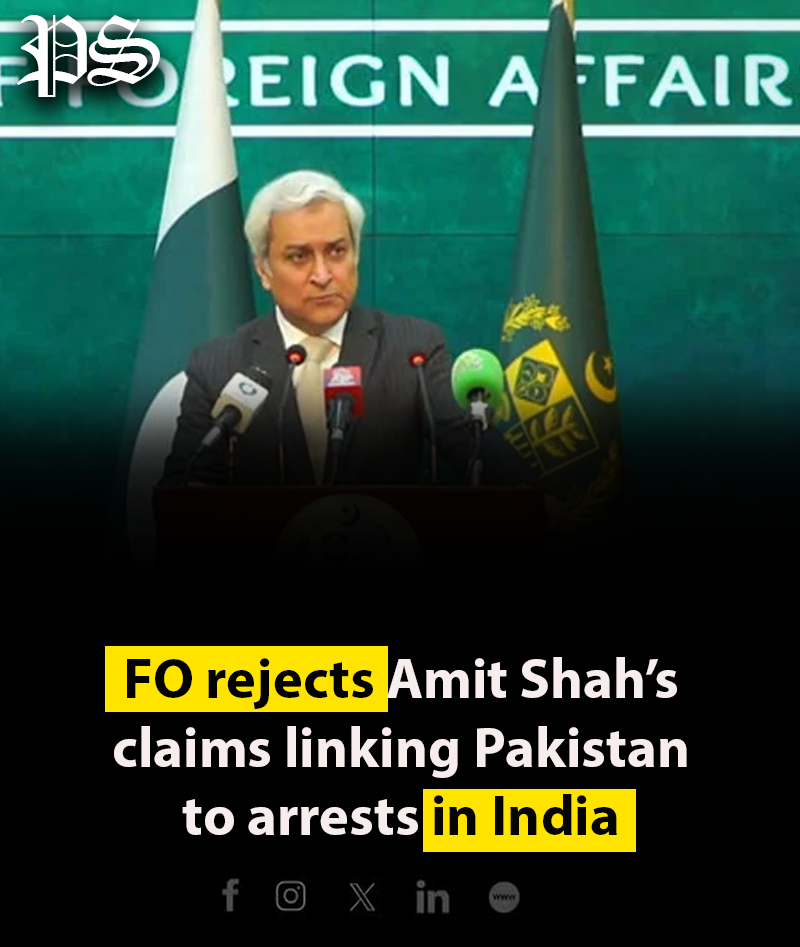
ISLAMABAD: Pakistan on Tuesday strongly rejected baseless allegations by Indian Home Minister Amit Shah attempting to link Pakistan with the arrest of alleged terror operatives in India, calling the claims baseless and misleading.
The Foreign Office spokesperson, Tahir Andrabi, issued the statement in response to remarks by Amit Shah on Monday, in which the Indian home minister claimed that Indian security agencies had busted Shahzad Bhatti Network and arrested more than 200 “terror operatives” linked to Pakistan, thwarting potential “subversive attacks” ahead of the country’s Independence Day.
Andrabi described Shah’s assertions as part of India’s “malicious campaign” against Pakistan.
“Such propaganda is yet another demonstration of India’s malicious campaign against Pakistan to divert attention from its domestic security challenges and to blame Pakistan for narrow domestic political gains,” the spokesperson said.
He said that India is a repressive state that brutally oppresses its minorities and silences dissent, while externally, it exports terror and abets terrorists.
“Unfounded Indian insinuations cannot divert international attention away from India’s state-sponsored terrorism, targeted assassinations, and subversion in foreign territories,” Andrabi said.
He added that Pakistan had repeatedly shared evidence of India’s involvement in terrorism and destabilising activities in Pakistan.
Referring to convicted and serving Indian naval commander Kulbhushan Jadhav, who is currently serving a sentence in Pakistan, the spokesperson said his case was undeniable proof of India’s direct involvement in subversion and terrorism in Pakistan.
Pakistan urged the international community to reject baseless Indian allegations and hold India accountable for its state-sponsored terrorism in the region, Andrabi added.
India refusing to accept defeat in Marka-e-Haq, says ISPR
Earlier, the Inter-Services Public Relations (ISPR) said that India is refusing to accept the bitter reality of its defeat in Marka-e-Haq and is attempting to portray its failed campaign as a success.
According to the military media wing, more than a year after Marka-e-Haq, India refuses to face the harsh reality. Instead of conceding defeat in a failed venture, India has decided to colour history in her preferred hues.
About The Author