

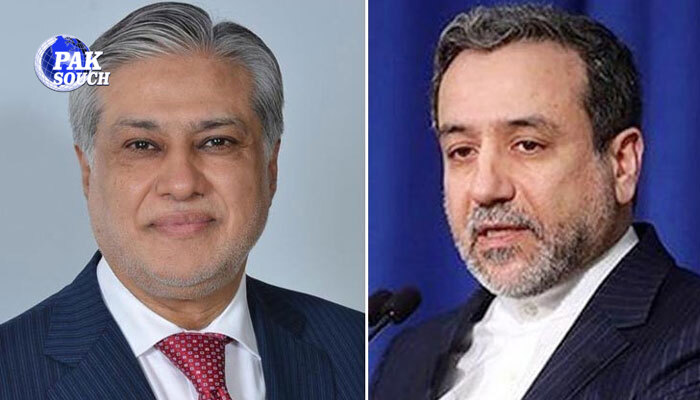
ISLAMABAD: Pakistan’s Deputy Prime Minister and Foreign Minister Ishaq Dar held a telephone conversation with Iranian Foreign Minister Abbas Araghchi, during which the two sides discussed the recently concluded Makkah Defense Agreement between Pakistan, Saudi Arabia and Türkiye, as well as the rapidly changing situation in the region.
According to Iranian news agency reports, Ishaq Dar contacted his Iranian counterpart to discuss developments in the region and the implications of the recently signed defense agreement. The two foreign ministers also exchanged views on efforts aimed at promoting peace, stability and security in the region.
The telephone conversation comes at a time when regional diplomatic and security developments have intensified, with several countries seeking greater coordination to address emerging challenges and prevent further instability.
During the conversation, the Iranian foreign minister reportedly briefed Ishaq Dar on Tehran’s recent discussions with Oman concerning the establishment of a new trade corridor in the Strait of Hormuz.
The Strait of Hormuz is one of the world’s most strategically important maritime passages and a major route for international energy and commercial trade. Any initiative aimed at developing alternative or additional trade routes in the area could have economic and strategic implications for countries in the region.
Araghchi shared details of Iran’s recent talks with Oman regarding the proposed trade corridor and brought his Pakistani counterpart into confidence about the discussions, according to the report.
The Pakistani foreign minister, meanwhile, briefed Araghchi on the Makkah Defense Agreement recently concluded between Pakistan, Saudi Arabia and Türkiye.
Dar explained Pakistan’s position regarding the agreement and emphasized that its objective was to strengthen strategic cooperation and contribute to peace and stability in the region.
The Makkah defense arrangement has attracted considerable regional attention since its conclusion, particularly because of the evolving security environment in the Middle East and South Asia. Iran has also been closely monitoring regional defense and diplomatic developments.
Pakistani officials have previously emphasized that the agreement should not be viewed as being directed against any particular country. The pact has been described in terms of strategic cooperation and collective efforts to strengthen regional security.
The two foreign ministers also discussed the broader regional situation and diplomatic efforts aimed at maintaining peace and stability. Their conversation reflects continued communication between Islamabad and Tehran despite the changing geopolitical environment.
Relations between Pakistan and Iran have traditionally been shaped by geographical proximity, shared cultural ties, economic interests and common security concerns. Both countries have repeatedly emphasized the importance of dialogue and cooperation in addressing regional challenges.
The latest telephone contact between Dar and Araghchi also highlights Pakistan’s efforts to maintain communication with neighboring countries while developing closer strategic relations with Saudi Arabia and Türkiye.
Iranian officials have previously stated that the Pakistan-Saudi-Türkiye defense cooperation should not be considered a threat to Iran. Iranian Foreign Ministry spokesperson Esmail Baghaei had said that the agreement should not be interpreted as a hostile move against Tehran.
The latest conversation between the two foreign ministers appears to reinforce the importance of diplomatic engagement at a time when regional alliances and security arrangements are undergoing significant changes.
For Pakistan, maintaining constructive relations with both Iran and Gulf countries remains an important aspect of its foreign policy. Islamabad has traditionally sought to avoid regional polarization while promoting dialogue and cooperation among neighboring and Muslim-majority states.
The discussion also comes against the backdrop of growing international attention toward the Strait of Hormuz. The waterway is crucial for global energy supplies, and developments affecting trade and navigation through the strait can have consequences far beyond the Gulf region.
Iran’s reported discussions with Oman regarding a new trade corridor could therefore become an important element of regional economic planning. By briefing Pakistan on these talks, Tehran appears to be keeping Islamabad informed about developments that could affect regional trade and connectivity.
During the call, both ministers reiterated the importance of continued diplomatic contacts and cooperation. They exchanged views on the evolving regional environment and efforts to promote peace and stability.
The conversation between Dar and Araghchi demonstrates that Pakistan and Iran continue to use diplomatic channels to coordinate on regional developments and clarify their respective positions on major security and economic initiatives.
While the Makkah Defense Agreement represents an important development in Pakistan’s strategic relations with Saudi Arabia and Türkiye, Islamabad has indicated that the arrangement is intended to support regional stability rather than create confrontation with neighboring countries.
The latest diplomatic contact between Pakistan and Iran is therefore significant as both countries navigate a complex regional environment. Continued communication at the foreign minister level could help address concerns, prevent misunderstandings and encourage cooperation on matters of mutual interest.
The two sides are expected to remain engaged as regional developments unfold, particularly on issues concerning security, trade, connectivity and efforts to maintain peace and stability.
About The Author